According to surveys in the US and the UK journalists and politicians rank 2 and 3 as the least loved professions. They are only outstripped by lawyers in the US, and estate agents (realtors) in the UK. The figures below are not surprising.

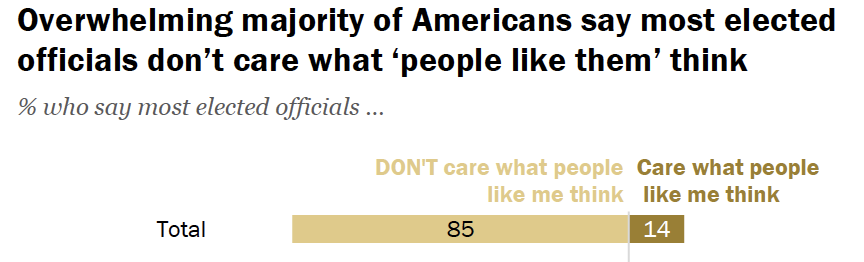
Source: Pew Research Center, 2024
Is the level of distrust and hostility towards these professions justified and proportionate? I don’t think so.
I’m going to focus mainly on politicians.
I am deeply interested in politics, have always been and, with a background in journalism, I read a fair deal about most major developments, and share plenty of my opinions. I’ve been asked, would I want to go into politics? And the usual answer is ‘no’.
Why? Because I don’t think I’m prepared to put in the large amount of unpaid time and effort to develop a political career – which would involve joining a party, actively attending meetings over a period of years, helping out with canvassing, delivering flyers, observing elections etc etc. After that, if I’m relatively successful, I might be selected to stand for a local council. If I’m then elected, that would mean attending multiple local municipal meetings and a lot of hard, mostly unpaid work.
None of this is remotely glamorous. None of this remotely fits the idea of megalomania, or narcissistic self-promotion – two of the commonly voiced accusations against politicians.
And what if you’re more successful and get elected as an MP or as a state or even national Congressperson? You’re generally a small fish in a large pond. Do you have ideas about how to improve society? You will have to work hard to make connections, persuade people to support a proposed bill, after probably supporting other people’s bills. You will, especially in the US, have to spend a lot of time raising money, attending party events and introductions, and sitting on committees. You will be under pressure from you own national party to follow their political line. You will constantly have to meet with your constituents, listen to their issues, learn as much as you can.
I’m fairly sure I’m not willing to do all of that. But I respect those who are willing to do it. A lot.
Anecdotally, having met people involved in politics, my general impression is that most of them genuinely want to help people and improve society. But that process is arduous, long and difficult. Most politicians, even at the higher levels, do not have huge power. They have to work under a constant media spotlight. They have to deal with huge amounts of public criticism – because almost whatever policy or politics you support will be strongly opposed by a large proportion of the electorate.
Are there pressures to compromise? Of course. Almost any significant new legislation is the result of compromise. New laws, new ideas, cannot simply be imposed on society. People have to be persuaded and influenced. You have to bring people with you. That is the art of politics and it’s not easy. Politics can also be a vicious business. You can slave away on some perfectly good proposal and not get anywhere with it, and only receive criticism.
And yet, when successful, usually after years of effort, politicians can and do make enormous positive differences for society. They bring in the National Health Service in the UK for example, or Medicare and Medicaid in the US. They bring in legislation to protect workers and the environment, to support vital medical research, to improve access to education and to pre-K care, to provide aid to developing countries and to people in difficulty in their own countries, to ensure excluded minorities can vote, to name but a few examples.
Are there many policies I disagree with? Yes, of course – but in a democracy, if someone is fairly elected and persuades enough people to vote for a measure, then I have to accept it – with the proviso that I can elect someone in the future who can change that policy.
Are politicians perfect? Of course not. Some are corrupt and mendacious. And some use their offices for personal gain. We all know examples of this. But is this the case for the majority of politicians? From what I’ve observed, I don’t think so.
I’ve been looking around for hard evidence of whether politicians are less honest than the general public – and there’s very, very little on this. There is one study which comes up a lot – but I hardly think it’s conclusive. 816 Spanish mayors were asked to flip a coin – if they got heads they would be sent a survey on truth-telling among politicians.
Of course, a majority of them were interested in this. More people said they had flipped heads instead of tails – 68% – instead of the expected 50% – which implies that 18% lied. I hardly think this proves a great deal. At the most, this is a harmless white lie in my opinion – no one was hurt, they simply wanted to read a study and it was a relatively trivial context. I mean, wouldn’t you be inclined to say you flipped heads? In fact, you could say the researchers themselves were lying, by tricking mayors into doing this, concealing that their own coin flip would be part of the survey results.
That seems to be the only study I can find on a quick search – and I don’t personally feel this shows anything substantial enough to draw general conclusions.
Sure, politicians are under pressure to spin their achievements. But that, I’m afraid, is allowed in a democracy. We are all allowed to try to persuade each other of the merits of a particular policy. This involves making a favourable case and emphasising the good over the bad. That is not the same as lying and, for me, is a legitimate part of any democratic debate.
To conclude, I think the intense dislike and hostility toward politicians, which is commonly expressed these days, is problematic. My honest belief is that most politicians are trying to do their best, often imperfectly, to bring about positive change. And we need to work with politicians and legislation to make productive advances.
Yes, the environment is often not good – there is far too much emphasis on having to raise money in the American system, for example – but that doesn’t mean that politicians, as a whole, are bad people who deserve our contempt.
Do I feel contempt for some? Yes I do. But I’m careful not to generalize that attitude. I don’t think that serves us at all.
(PS – this post is about politicians, but, briefly, on journalists. I may be biased because I was a journalist with the BBC for 11 years. But I do remember that we were expected to report fairly and accurately – everyone who worked for the BBC. Every piece on politics that I created ALWAYS included a perspective that I didn’t agree with (since my perspective is left of centre). We knew we couldn’t violate that, and we would have been bollocked by our editors if we had done so. I am a fervent believer in this kind of journalism – after all, the overwhelming majority of us rely for most of our information on journalists.
Yes, there’s also space for commentary – but there we understand that we are NOT getting an impartial view of the news, representing a range of views. Instead we are getting someone’s viewpoint and interpretation of what is going on. All well and fine, so long as we don’t take a commentary as being impartial news reporting. There’s room for both – and good, accurate journalism is absolutely vital in a functioning democracy. That’s precisely why authoritarians always threaten accurate journalism and try to close it down.
Are there irresponsible journalists and irresponsible outlets – yes, but please don’t tar ALL of journalism with the same brush – you’re almost certainly relying on journalists for the information you have right now. There are plenty of worthy and hard-working journalists – their job is vital and it is up to us to support them – especially when they are threatened.)
 francismead.com
Leave a comment